As winter approaches, energy efficiency remains a challenge year-round. In industrial automation, the focus is shifting beyond cost savings towards decarbonisation, grid resilience, and smarter, data-driven maintenance.
In this blog, we explore practical ways to reduce energy consumption this winter and beyond through industrial automation and control applications.
Over 70% of all industrial electrical energy goes into powering up electrical motors.
Inverters are just one way that will help you in your search for energy-saving applications. Inverters, also known as Variable Speed Drives (VSD), Variable Frequency Drives (VFD) or AC Drives, offer speed or torque control of your electric motors. Sitting between the electrical supply and motor, these drives regulate the power and frequency needed for your motor to run.
Most motors are designed to rotate at a set speed based on the number of magnetic poles built into them and the supply voltage and frequency applied. They cannot alter their speed. Variable speed drives not only control the speed of electric motors, but they offer better process control, gentle starts and stops and can even help improve power factor.
Often processes vary in demand over the day so having the ability to turn down the speed of the motor during low demand is extremely beneficial. But there is so much more to gain than just a smooth operating system. When you reduce the speed of an electric motor, especially on a pump or fan, you reduce the amount of energy that is used. Whilst you might think such a difference would be minuscule, the savings in both energy and costs can be substantial!
Reducing the speed of the motor using an inverter drive can help you save up to 50% in electricity (units consumed). If the load is a constant torque load, the power will be proportional to the speed. A constant torque load is one where the load doesn’t change too much with speed. However, in these applications process control is often more important than energy saving.
Inverters are widely used in factory automation to smoothly control pumps, dampers, fans, air conditioning and more. They also play a key role in efficiently converting electrical energy, helping industrial equipment reduce energy consumption and improve overall efficiency.
Significant energy savings can be especially achieved when using an inverter drive with fans or pumps.
To get the best out of your drive, don’t just turn the speed down a little and hope the process won’t be affected. Other products will complement the drive and ensure your application is really energy efficient. Sensors that connect back to the drive can help maintain the flow rate, temperature or pressure automatically. Timers can help your motor/fan run all the time, selecting a slower speed at night and weekend.
Applications for inverters
Commercial Premises: In offices and public buildings, inverters optimise energy consumption by precisely controlling electric motors in HVAC systems, including fans, chillers, pumps and cooling towers.
Industrial and Manufacturing: For industrial and manufacturing facilities, inverter technology delivers substantial energy reductions for conveyors, compressors, cooling towers, mixers, pumps, fans, chillers and extruders.
Warehousing and Logistics: In warehousing and logistics operations, inverters effectively reduce energy usage in large HVAC systems.
Heavy Industries: Quarries, metals, and mining operations can leverage inverters to control crushers, pumps, extract fans, conveyors, hydraulic power packs and compressors, resulting in lower energy consumption and improved process control.
Water Management: Water companies benefit from inverters by reducing energy consumption and enhancing process control for various pump applications.
Our Top inverters
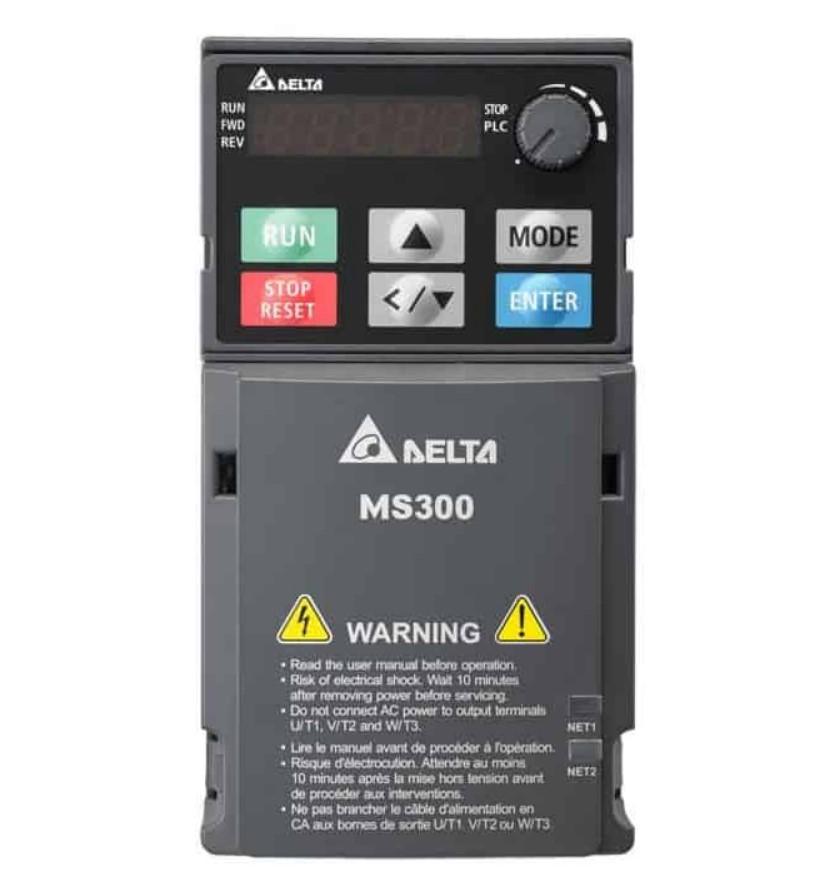
MS300 Delta Drives
M1 OmronDrives
DM1 Eaton Drives
The Delta MS300 is a compact and versatile drive designed for a wide range of industrial automation applications.
It provides precise control of motors, helping to optimise machine performance while reducing energy consumption. With its compact design and flexible features, the MS300 is well suited to applications such as pumps, fans, conveyors and other industrial equipment.
The Omron M1 variable speed drive is an integrated global solution that delivers the flexibility and efficiency you need to design and build smarter machines.
With its EtherCAT® integration and unified software solution, the M1 drive helps you save space, reduce downtime, and improve energy efficiency. The M1 drive supports a wide range of motors.
The PowerXLTM DM1 variable frequency drives combine maximum functionality in combination with a small footprint.
The devices can be used wherever space is limited, but where the functionality of a standard universal drive is nevertheless required.This includes pump and HVAC applications as well as the control of conventional motors such as asynchronous or PM motors
CALL TO GET YOURS NOW
The actual energy savings depend on the equipment, how it is operated, its load profile and the efficiency of the inverter itself. An inverter doesn't automatically make every electrical system more efficient, but when it enables equipment to match its energy use to actual demand, the potential savings can be significant.
If you’re looking for the best solution for your needs, get in touch with us today. We can help you find the right inverter solution and take the next step towards saving energy and reducing your energy costs.
If you are a high-energy user and want to have more information on how inverters can help your energy consumption, please contact your local branch.